

 Contact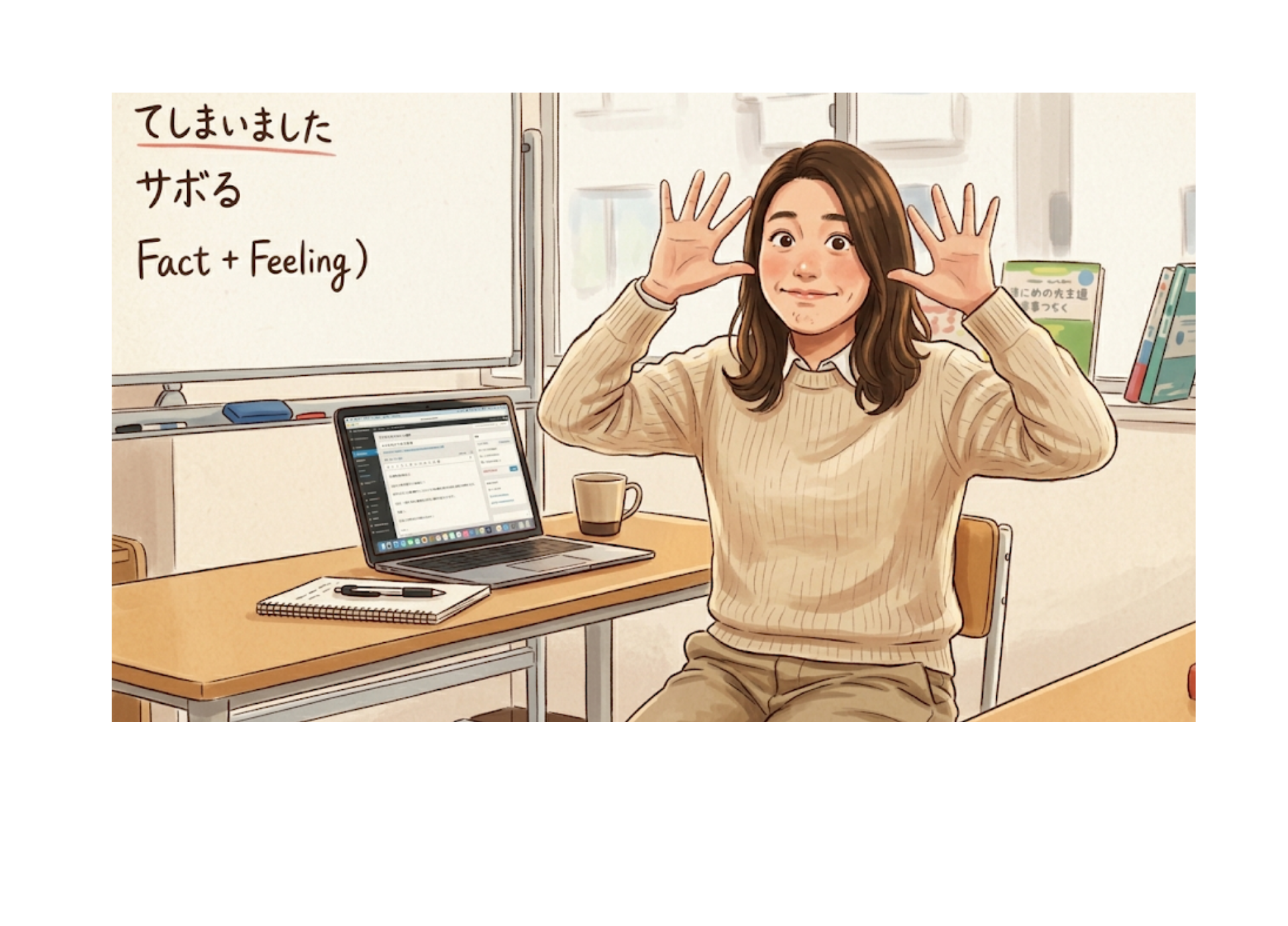
 ことのは
ことのは 「サボってしまいました」=「事実」+「きもち」の法則
みなさん、こんにちは。お久しぶりです。
また、ブログの更新をサボってしまいました……。
ここで少し、日本語のお話をしましょう。
「ブログをサボりました」と「サボってしまいました」。 この2つ、事実は同じですし、英語に訳すとどちらも同じ表現になるかもしれません。
でも、日本語としてのニュアンスは大きく違います。
「〜てしまいました」は、自分の行動に対して「後悔」や「残念」という気持ちを表すときに使う表現です。
「サボりました」はただの事実。その事実に、「あぁ、やってしまった」「残念だな」という私の「regret」がプラスされると、「サボってしまいました」になります。
つまり、「〜てしまいました」は、日本語の「regret feeling」を表す特別な形です。 これをわかりやすく「分解」してみると・・・
- サボりました (=事実:Fact)
- だから、ちょっと後悔しています。残念です。 (=気持ち:Feeling)
です。この2つをつなげると、「サボってしまいました」になります。
英語だと “I skipped my blog, and I feel bad about it.” のように、言葉を足して説明する必要がありますよね。でも、日本語はわざわざ「残念です」と言葉に出して言いません。センテンスの形を少し変えるだけで、そのニュアンスを含めることができるんです。
おもしろいのは、日本語では「後悔しています」と言葉に出して言わなくても、この「〜てしまいました」という形にするだけで、その気持ちを相手に伝えられるという点ですよね。
以前もお話ししましたが、言葉の裏にある「心」を形にする、日本語らしい表現の一つです。
さて、私の今回の「サボってしまいました」に込めた後悔の気持ち、皆さんに伝わりましたか?
自分の気持ちを言葉の形で表現できる「〜てしまいました」。皆さんも、もし何か失敗してしまった時は、この形を使って素直な気持ちを伝えてみてくださいね。
なるべく、サボらずに更新しますので、また覗きに来てくださいね!
。

The formula of “Sabotte-shimaimashita” = “Fact” + “Feeling”
Hello everyone! It’s been a while. I have to admit… I’ve ended up slacking off on my blog updates again.
Let’s take a moment to talk about the Japanese language. What is the difference between “Blog wo saborimashita” and “Sabotte-shimaimashita”? The factual event is the same, and if you translate them into English, they might both sound like the same expression. However, in Japanese, the nuance is quite different.
“~te shimaimashita” is an expression used when you want to show feelings of “regret” or “disappointment” toward your own actions. “Saborimashita” is simply a fact.
When you add my “regret” — that feeling of “Oh no, I did it again” or “I feel bad about this” — to that fact, it becomes “Sabotte-shimaimashita.”
In other words, “~te shimaimashita” is a special Japanese structure to express a “regret feeling.” If we break it down simply:
- Saborimashita (= Fact)
- …and I regret it a little / I feel disappointed. (= Feeling)
When you combine these two, you get “Sabotte-shimaimashita.”
In English, you might need to add extra words to explain it, like “I skipped my blog, and I feel bad about it.” But in Japanese, we don’t always say “I’m disappointed” out loud. Just by slightly changing the verb form, you can include that entire nuance.
Isn’t it interesting? In Japanese, even if you don’t explicitly say “I regret it,” you can convey that emotion to the other person just by using the “~te shimaimashita” form. As I’ve mentioned before, this is one of those characteristically Japanese expressions that gives a physical “shape” to the heart behind the words.
So, did my feeling of regret in “Sabotte-shimaimashita” reach you this time?
“~te shimaimashita” allows you to express your feelings through the grammar itself. If you ever make a mistake, try using this form to share your honest feelings.
I’ll try my best to update without slacking off, so please come and visit again!